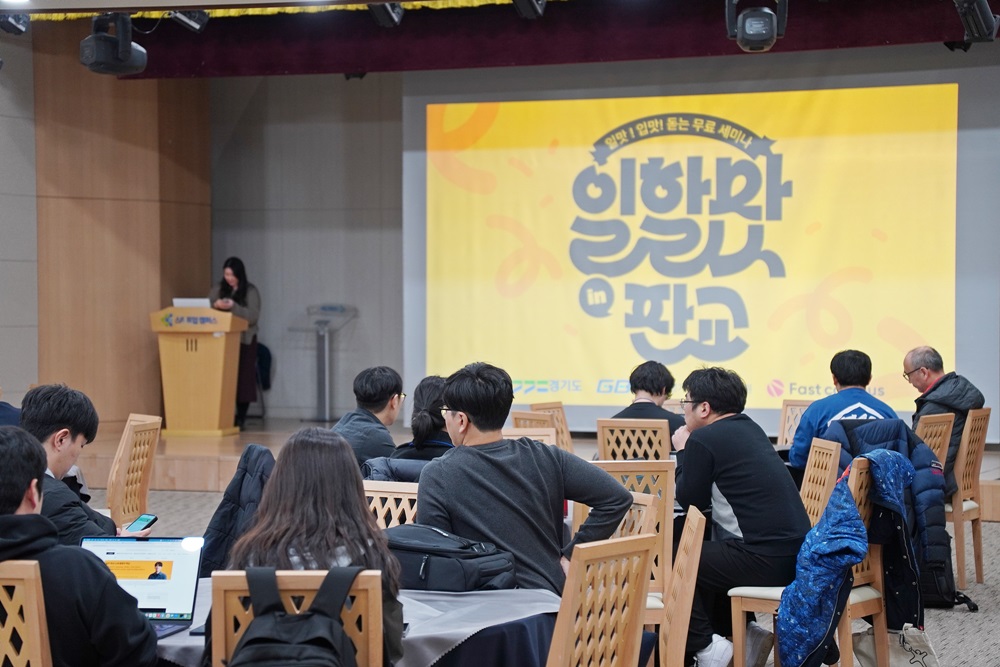
The December “Joy of Work in Pangyo” seminar gets underway
The Gyeonggi Business & Science Accelerator (GBSA) held the December session of “Joy of Work in Pangyo” on the evening of December 11 at the Pangyo Techno Valley Startup Campus in Seongnam. “Joy of Work in Pangyo” is an offline learning and networking program designed to strengthen practical skills and foster exchanges among professionals in the Pangyo area, and it is held monthly at the Startup Campus. The December seminar was organized under the theme “Review of 2025 AI Trends and Outlook for 2026.”
The event was held in a hybrid format, with live streaming. It consisted of an opening session with greetings and an overview, followed by three seminar sessions and a networking segment. Session 1, titled “Key Points of Practical LLM Utilization,” was led by Guijin Son, who serves as CDO of OneLineAI and is also a co-lead of the HAERAE LAB at MODULABS.
Session 2, “Ontology: AI Transformation Strategy Through Knowledge Graph Structuring,” was presented by Justin Kim. Kim is a researcher and Ph.D. in engineering specializing in ontology and symbolic artificial intelligence, and he introduced knowledge graph–based AI transformation strategies grounded in his experience in corporate software development. Session 3, titled “From Repetition to Accumulation,” was delivered by Dongjun Lim (Makerjun), who currently works as a frontend educator at Woowa Bros.
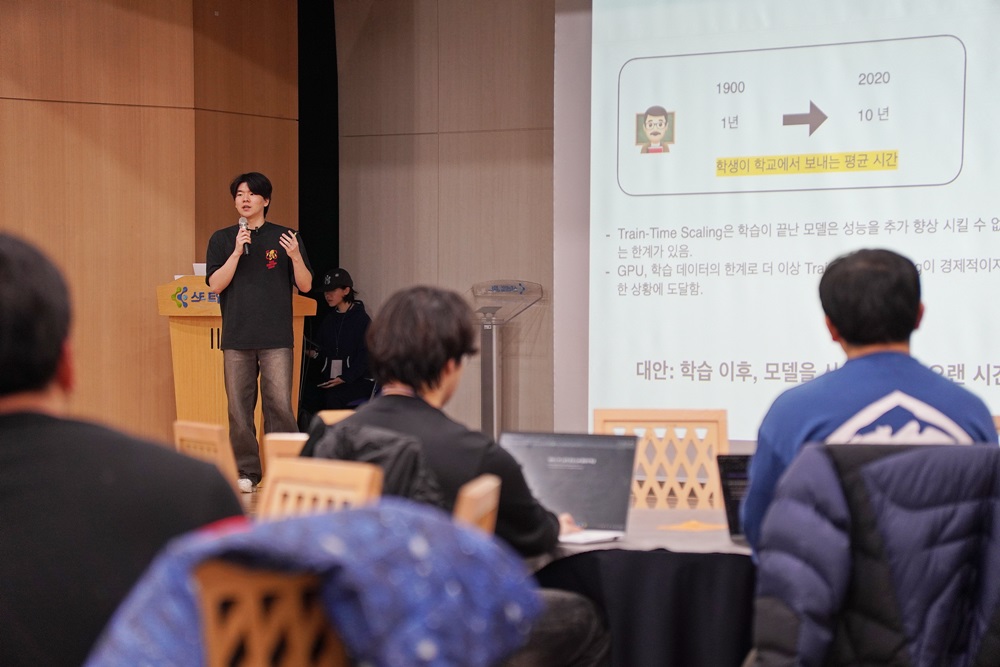
In Session 1, Son explained that over the past three years, competition in large language models has primarily centered on a scaling strategy summarized as “bigger models trained longer become smarter.” However, he noted that this approach is increasingly reaching its limits due to resource constraints, including data and GPU resources. He pointed out that the total volume of high-quality data is finite. Since 2023, the growing share of online content produced by generative AI has made data selection for training more difficult. As a result, the industry’s focus is shifting away from simply increasing training volume toward extending inference time so that models can “think longer,” with reinforcement learning regaining attention as a supporting approach.
Regarding reinforcement learning, Son emphasized an approach that differs from having models memorize solution steps, such as fixed answers. Instead, he highlighted training methods that enable models to explore solutions on their own, guided by verifiable reward signals. He added that for such training to be practical, high-difficulty problems that are hard to solve by guesswork are essential, making the ability to secure and design good problems a new source of competitiveness. He also noted that, in cases where models are relatively small or not yet sufficiently capable, fine-tuning methods such as supervised fine-tuning (SFT) remain widely used rather than reinforcement learning.
Looking toward 2026, Son identified several key technology themes: inference design that enables longer reasoning, engineering competition centered on speed and memory driven by the spread of Mixture of Experts (MoE) architectures, quantization-aware training (QAT) and low-precision deployment strategies, and the growing importance of tool-use capabilities and structured outputs. He explained that in environments connected to practical tools such as MCP or Text-to-SQL, success depends less on how eloquently a model speaks and more on how accurately it can call tools in the correct format. He also stressed that the criteria for model selection increasingly consider not only performance itself but also the cost required to meet target benchmarks.
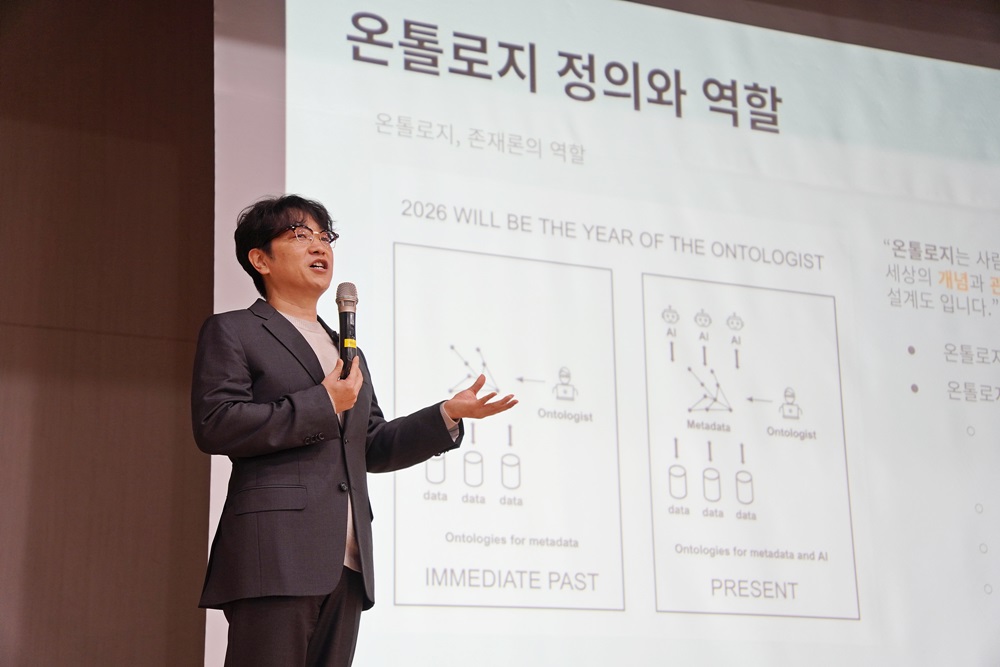
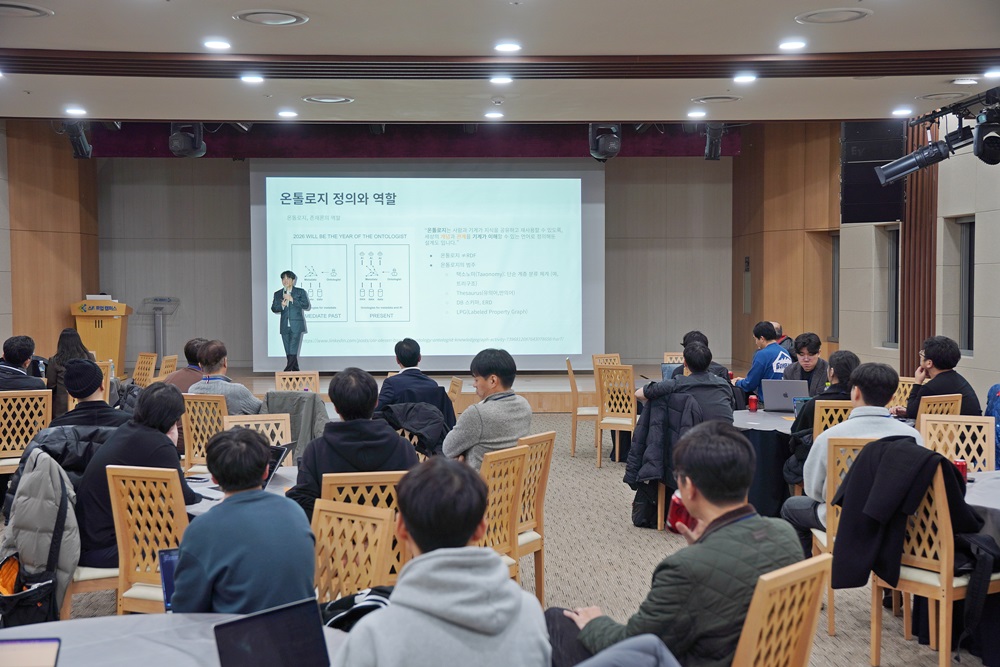
In Session 2, Justin Kim continued with a presentation on AI transformation strategies based on ontology, covering the role of ontology, methods for structuring knowledge from a knowledge-graph perspective, and processes and expansion strategies for building knowledge systems. Session 3 concluded the seminar by sharing messages on how individual and organizational execution and learning can move “from repetition to accumulation.” In the final networking session, on-site participants freely exchanged experiences and discussed practical insights and areas of interest.
GBSA plans to continue the “Joy of Work in Pangyo” series as a regular seminar program, enabling employees of Pangyo Techno Valley companies and members of the startup ecosystem to share the latest technology trends and real-world application cases. The program will focus on high-demand topics such as AI, data, and software development, combining lectures with networking to enhance practical skills among local talent and expand inter-company exchanges. Through these efforts, GBSA aims to strengthen the innovative capacity of Pangyo Techno Valley and broaden opportunities for growth and collaboration among startups and companies.
Pangyo Techno Valley is a global R&D hub that integrates Research (R), People (P), Information (I), and Trade (T) across the IT, BT, CT, NT, and mobility sectors. It is a leading innovation cluster in Gyeonggi-do, established to drive technological innovation, talent development, job creation, and international business competitiveness.
The Gyeonggido Business & Science Accelerator’s Techno Valley Innovation Group has continuously promoted Pangyo Techno Valley’s value by hosting events such as the Pangyo Evening Meet-Up, Pan-Pan Day, Joy of Work in Pangyo, and Pangyo Startup Investment Exchange - In-Best Pangyo. These initiatives have facilitated networking between Pangyo companies, domestic and international investors, and the media. Similar events are planned for this year to support the growth and global expansion of Pangyo startups through various assistance programs.