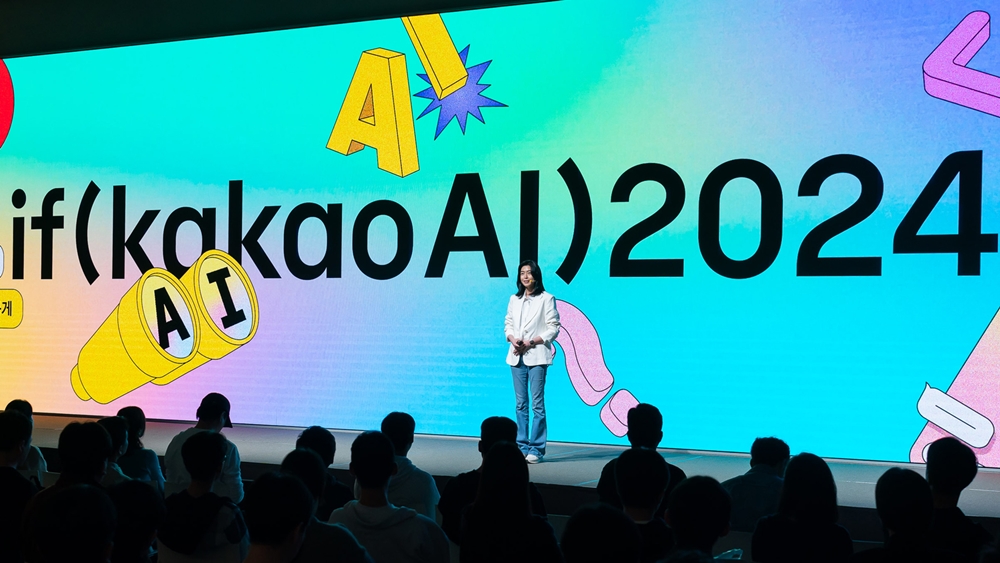
A scene from if(kakaoAI) 2024 | Photo by Kakao
Kakao has revealed a lineup of advanced AI models as part of its technology and service strategy at its developer conference ‘if(kakaoAI) 2024’. On October 23, during the event’s second day, Kim Byung-hak, leader of Kakao’s Kanana Alpha team, presented the company’s achievements and future AI plans. He stated, “Kakao continues to push forward in the race toward AGI (Artificial General Intelligence) and aims to support advancements in AI models that will benefit all of South Korea, not just Kakao itself.”
Kakao introduced its new unified AI brand, “Kanana,” with plans to use the models to launch AI services that provide practical value to users. Kakao noted that its “service-optimized LLM” (Large Language Model) should offer strong performance, cost-efficiency, and the ability to solve service-specific issues.
Kim highlighted three key conditions for optimized LLMs: conversational abilities that allow for interactive engagement, accurate knowledge-based responses, and the capacity for action-based continuity in conversations. He believes these will add new dimensions to Kakao’s services.
The new Kanana brand includes various models: three language models, three multimodal language models, two visual generation models, and two voice models. Kim noted Kanana’s strengths in Korean language proficiency, transparency through high-quality training data, and cost-efficient service optimization.
Among the language models, “Kanana Essence” stands out for its streamlined size and optimized performance, balancing cost-effectiveness with high-quality results. Kakao’s training methodology for Kanana Essence involved multi-stage learning, curation, and pre-processing of proprietary datasets, resulting in a model that matches or outperforms similarly sized global models, especially in Korean logic and reasoning tests like KMMLU and HAE-RAE. “Kanana Nano” offers excellent performance in Korean language capabilities for mobile devices and is a competitive lightweight model.
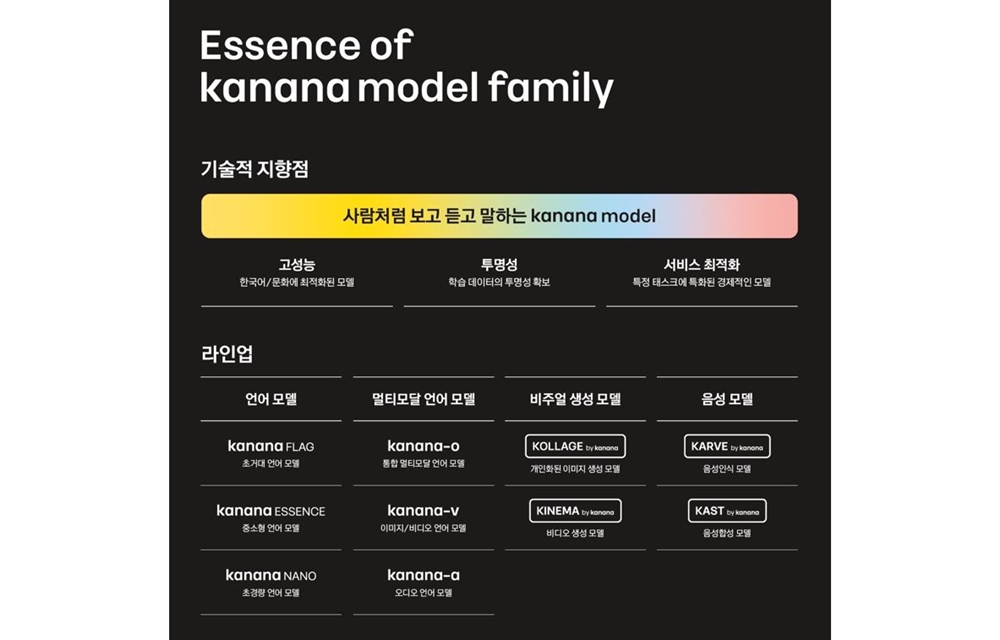
Explanation of Kanana Model Family | Image by Kakao
Alongside these models, Kakao presented the “Instruct model,” designed to ensure clear response alignment and user safety. This model blocks potentially harmful information and exhibits strong performance across diverse benchmarks. Kakao also develops task-specific models, such as RAG, Function call, and summarization, to enhance service-specific abilities.
Kakao’s largest model, “Kanana Flag,” is undergoing training. The company is determined to maintain competitive advantages through continuous innovation and the development of high-performance models that benefit users and support the AI ecosystem.
In the multimodal category, Kakao introduced “Kanana-o,” an advanced model integrating text, audio, and visual data for seamless, fast interactions, generating responses in about 1.6 seconds. This model’s unique “Omni” structure moves beyond modular integration, allowing it to handle diverse data types in a unified system. For example, users can soon interact with objects in real-time through the camera, enabling dynamic responses across different formats.
Finally, Kakao showcased its two visual generation models: “Kollage by Kanana” for images and “Kinema by Kanana” for video. These models are designed to generate rich, customizable content through simple inputs, including text and user profile photos, facilitating easy control over character movement and camera angles to create engaging video content.
Kim emphasized, “The value of technology lies in its practical application, where it directly solves user issues and provides tangible value.” Kakao aims to integrate Kanana models into its AI services and boost productivity across Kakao’s internal teams, advancing its mission to become an “AI-native” company.
Pangyo Techno Valley is a global integrated R&D hub focused on IT, BT, CT, and NT, integrating Research (R), People (P), Information (I), and Trade (T). As Gyeonggi-do’s representative innovation cluster, Pangyo Techno Valley was established to secure national new growth drivers such as technological innovation, human resource development, job creation, and enhancing international business competitiveness. As of 2023, 1,666 companies employ 78,751 people, and it has positioned itself as the most innovative hub in South Korea, with sales amounting to 167.7 trillion KRW (125.5 billion USD).
Furthermore, the Techno Valley Innovation Division of the Gyeonggi-do Business & Science Accelerator (GBSA) holds monthly events such as the Pangyo Evening Meet-Up, Pan-Pan Day, and the Pangyo Startup Investment Exchange “In-Best Pangyo” to maximize the value of Pangyo Techno Valley. They also support the Pangyo Overseas Promotion Program to publicize information about Pangyo’s companies, products, and services to domestic and foreign investors and the media, thereby facilitating foreign investment.